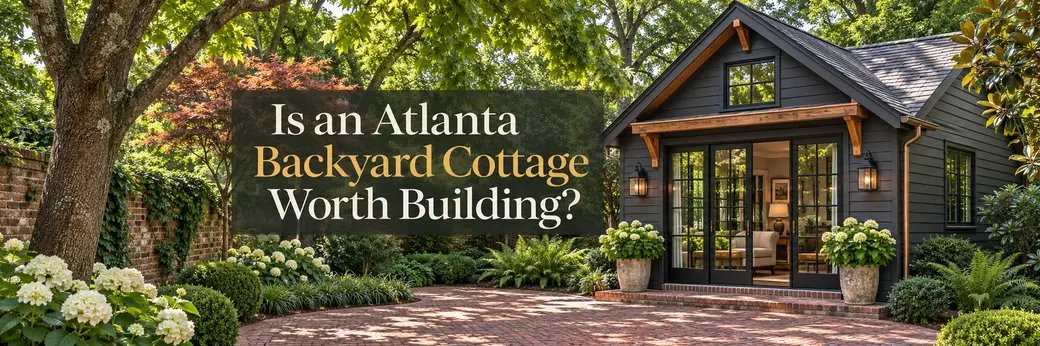
Is an Atlanta Backyard Cottage Worth Building?
By Jules Harper | November 18, 2026
A backyard cottage sounds like the rare Atlanta real estate project that checks every box. You get a little rental income, a place for someone you love to live, and a reason to stay in the home you already enjoy.
Then the builder walks the lot. The only access is a narrow side yard. The utility connection is farther away than you thought. And the rent you penciled in turns out to be what a larger apartment with dedicated parking is asking, not what a comparable cottage actually leased for.
I like backyard cottages. I like them best when the owner knows exactly what job the cottage needs to do. If you’re building for rental income, make it earn its place on paper. If you’re building so someone you love can live close by, compare it with what you’d spend to solve that problem another way. Both can be smart decisions. They don’t belong on the same spreadsheet.
Can you build a backyard cottage on your Atlanta lot?
A backyard cottage is one type of accessory dwelling unit, or ADU. It’s a separate, smaller home on the same lot as the main house. Atlanta’s Department of City Planning identifies R-4, R-4A and R-5 as districts where detached ADUs can be built without a zoning variance when they meet applicable standards. Some special and historic districts also allow them. That does not mean every lot in those districts has room for one or that you can skip permits. Atlanta Department of City Planning
This matters now because Atlanta is rewriting its zoning code. As of November 18, 2026, the official ATL Zoning 2.0 project site says Draft V3 is underway. If you’re pricing a property or planning construction today, use the adopted rules the city confirms for your parcel. Don’t pay extra for an option you’ve only seen in a draft. ATL Zoning 2.0
Start with the City of Atlanta’s parcel and zoning tools, then ask planning staff about setbacks, lot coverage and any district-specific review. An Atlanta mailing address alone is not enough to establish city jurisdiction. If you’re comparing properties across Atlanta, Cobb County and Marietta, check each parcel with its own jurisdiction rather than carrying one city’s rules over to the next address. gis.atlantaga.gov
Walk the lot before you fall for the floor plan
Picture a narrow Grant Park lot with a deep backyard, then a sloping lot in East Atlanta. Either might look generous in listing photos. But one may have limited access for construction, while the other may need grading, drainage or a retaining wall. Those are examples of site conditions, not assumptions about either neighborhood.
Ask your builder and designer where equipment would enter, where water and sewer would connect, which trees or easements could affect placement, and how someone would get from the street to the cottage on a rainy night. On a designated historic property, ask the city early whether exterior work needs a Certificate of Appropriateness. A good site plan shows how both homes will live once the work is done, not just where the new walls will fit. Atlanta, GA
What would the cottage actually earn?
Start with comparable signed leases, where available. A detached cottage with a private entrance and outdoor space isn’t the same product as a studio over a garage or a new apartment with a gym. Compare the things a renter will notice every day: the entrance, light, laundry, parking, privacy and whether utilities are included.
Next, get an all-in project budget. Include design, survey work, permits, utility work, site preparation, construction and contingency. Then estimate vacancy, maintenance, turnover, incremental taxes and insurance, any utilities you’ll pay, and management if you won’t handle it yourself. Don’t count on short-term bookings to rescue the numbers. Atlanta has a separate short-term rental licensing process, and you should confirm eligibility for the exact property and setup before projecting nightly revenue. Atlanta, GA
Here’s an illustration, not an Atlanta cost or rent estimate. Suppose the cottage costs $180,000 all in. You collect $1,500 a month for 11 months and set aside $4,500 for annual operating costs and reserves. That leaves $12,000 before debt payments and income taxes, about 6.7% of the project cost. Add a hypothetical $1,050 monthly loan payment, and the project is $600 cash-flow negative for the year. At $1,350 a month and ten occupied months, the shortfall grows to $3,600 on the same assumptions.
If you’re buying a property with an existing cottage, ask your lender what rent can actually count toward qualification. Fannie Mae’s September 2, 2026 guidance limits eligible ADU income to certain transactions and caps it at 30% of total qualifying income. A lender’s willingness to count rent on an existing unit is not an approval to borrow against rent from a cottage you haven’t built. Fannie Mae
What if the best return isn’t rent?
A cottage might let a parent live independently nearby or give you room to care for someone without leaving the block you love. Put a real alternative beside it: renting a nearby apartment, buying a larger home, or adapting the main house. Include the cost of moving and what you’d give up by leaving. That’s a more honest comparison than assigning the cottage rent nobody plans to collect.
Design around the first use, but leave room for the next one. A step-free entry where the site allows it, a well-lit path and a layout that offers privacy to both homes can make the cottage easier to live in today and more adaptable tomorrow. Ask yourself what happens if your plans change in three years. Could you comfortably carry the cost while the unit sits empty? Could you lease it if the rules and your financing allow? Would you still enjoy the backyard?
My rule: Build it for a use you can name today, at a cost you can carry without the best-case rent. If it passes that test, a backyard cottage can give you something especially valuable in Atlanta: the freedom to change how you live without having to change where you live.
Considering an Atlanta home with a cottage or a lot where you’d like to build one? Contact Jules Harper and The Four Walls Group at AtlantaKeyHomes.com to compare properties and identify what to verify before you commit.
Categories
Recent Posts